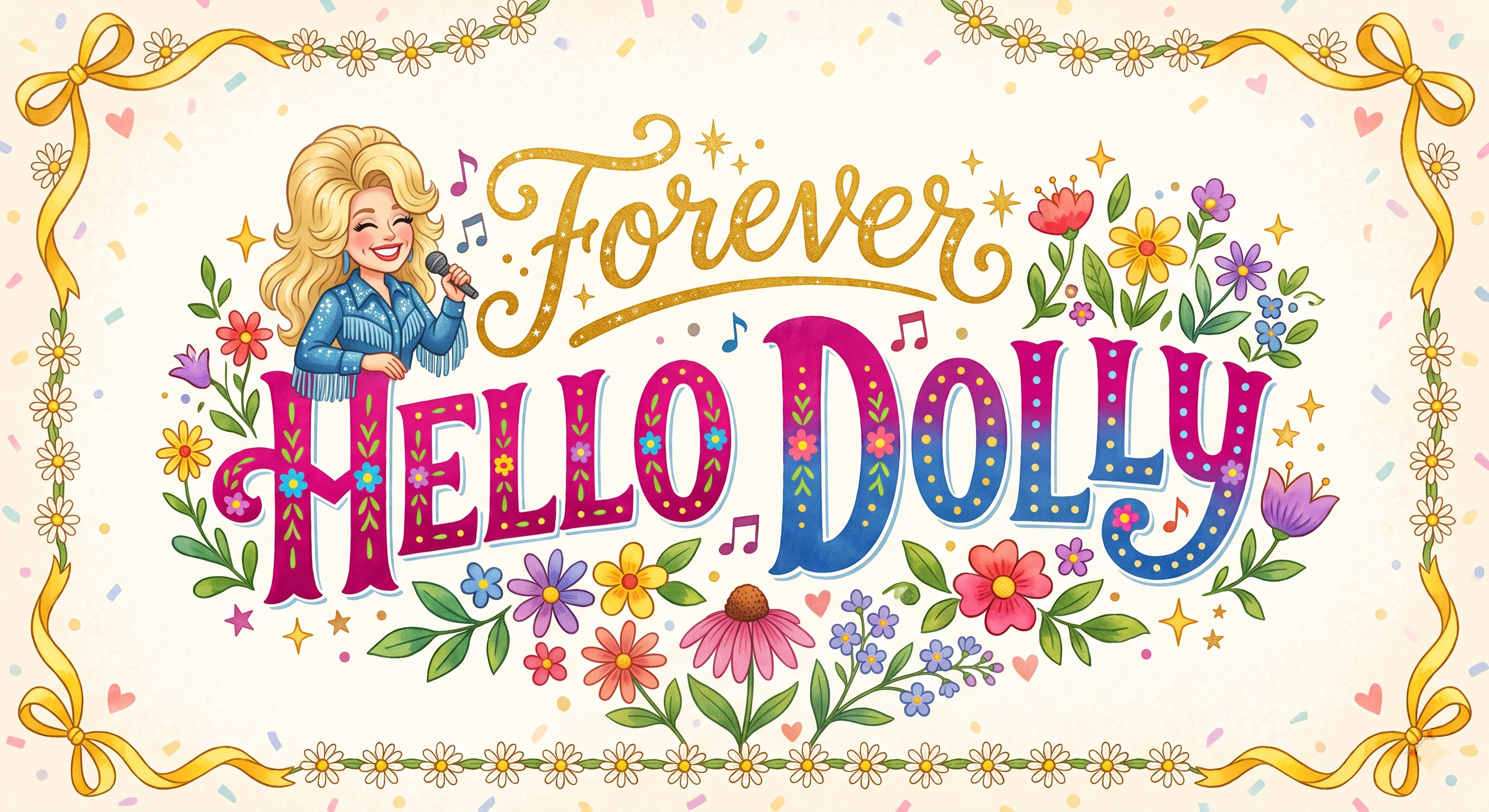
Forever Dolly: On Legacy, Reinvention, and Being Impossible to Copy
She wrote her own myth, and then handed the tools to build one to everyone who came after her.
Dolly Parton died today at 80, and the tributes pouring in from every direction — country radio, drag stages, Nashville songwriters' rooms, pop charts she never chased but conquered anyway — are proof of something she understood before almost anyone else in her business: a career built on genuine authorship outlasts a career built on image alone. She had both. That's the part people keep underselling.
The songwriter underneath the spectacle
It would have been easy for Parton to let the wigs, the rhinestones, and the persona become the whole story — she leaned into all of it herself, gleefully, for six decades. But the reason that persona had staying power instead of expiring with a trend cycle is that it sat on top of a genuinely serious catalog. She wrote her own songs from the beginning, at a time when very few women in country music were allowed anywhere near a writing credit, let alone treated as the primary reason a record worked. That distinction — spectacle as armor, songwriting as the actual engine — is a template, not an accident, and it's one a lot of artists have consciously or unconsciously borrowed from since.
The artists who kept her alive before today
Influence is easy to claim and hard to prove. Parton's is unusually easy to point to directly, because so many artists have said so themselves, on the record, in their own words:
Whitney Houston took a song Parton wrote as a farewell to a professional partnership and turned it into one of the defining vocal performances of the modern pop era — proof that a song built from real, specific circumstance can still travel anywhere.
Amythyst Kiah, an Appalachian singer-songwriter working in rock rather than country, has pointed to Parton's regional vocal identity — that unmistakable mountain sound — as a real blueprint for how to explore other genres without ever losing where you're actually from.
Trixie Mattel, the drag performer and musician, has credited Parton's fearless, self-aware relationship with her own image as a foundational influence on drag as an art form — someone who understood that performing an exaggerated version of yourself could be armor, joke, and genuine self-expression all at once.
None of these three artists sound like her. That's the actual proof of a real influence rather than a surface one — imitators copy the wig and the accent; the artists who actually absorbed something from Parton took a principle, not a style, and built their own thing out of it.
Why "timeless" isn't a cliché here
Parton spent the last stretch of her career doing something genuinely rare for an artist of her stature: she kept working in the present tense instead of touring as her own tribute act. New songs, new collaborations, new causes, right up to the end — including her continued literacy work, sending books to children for free, an initiative that will keep operating long after today. "Timeless" gets used loosely about a lot of legacy artists. In her case, it's literal: the songs keep getting reinterpreted by new artists, the persona keeps getting cited as a reference point by people working in entirely different mediums, and the actual philanthropic infrastructure she built keeps running. That's not a metaphor for living forever. That's just what living forever looks like in practice.